
We’ve all been there. You type a quick request into an AI—something like “Write me a marketing plan” or “Code a weather app”—and what do you get? A wall of “generic fluff.” It’s technically correct, sure, but it’s soul-less, shallow, and frankly, a bit Mid-wit.
The year is 2026, and the honeymoon phase of simply “using” AI is over. Today, the world is divided into two camps: those who use AI as a fancy search engine, and those who treat it as a high-level cognitive partner. To join the latter, you have to bypass the basics. You have to unlock System 2 Thinking.
In psychology, System 1 is fast, instinctive, and emotional. System 2 is slower, more deliberative, and logical. By default, LLMs (Large Language Models) want to give you a System 1 response because it’s computationally cheaper and faster. If you want the “Deep Magic,” you have to force the model to slow down.
Here is your definitive guide to the 10 Secret Prompts (and the philosophy behind them) that will turn you into a master of the machine.
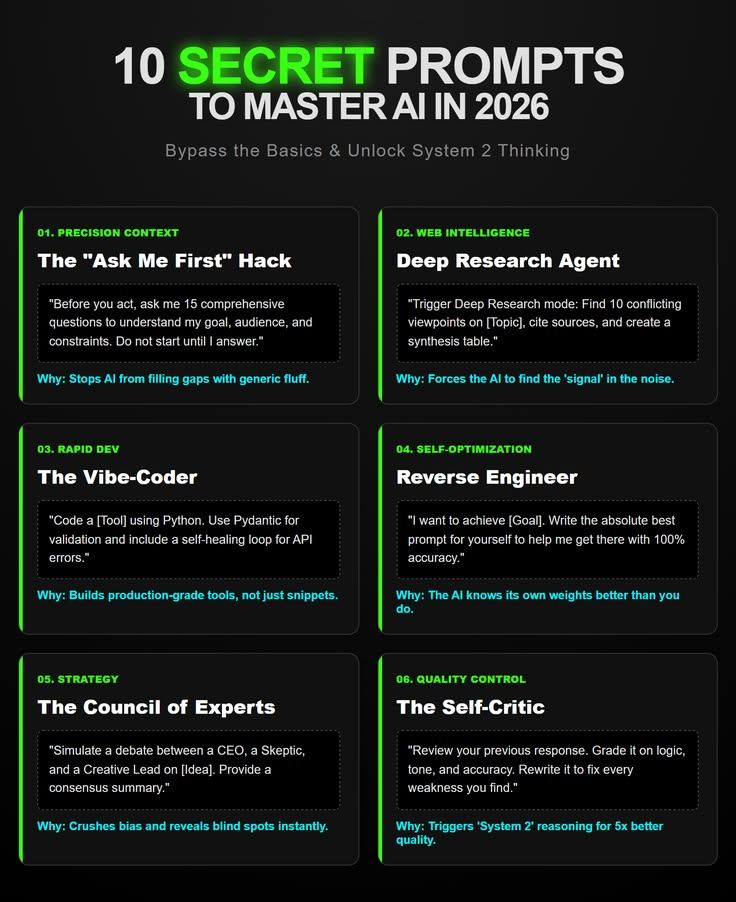
01. The “Ask Me First” Hack
Category: Precision Context
Most people fail because they don’t give the AI enough information. But here’s the secret: you don’t even know what information the AI needs.
The Prompt:
“Before you act, ask me 15 comprehensive questions to understand my goal, audience, and constraints. Do not start until I answer.”
Why it works: It stops the AI from filling gaps with assumptions. By forcing the AI to interview you, you ensure the foundation of the project is built on your specific reality, not a statistical average of the internet. It turns the AI from a subservient clerk into a consultant.
02. Deep Research Agent
Category: Web Intelligence
The internet is a noisy place. If you ask for a summary of a topic, the AI will likely give you the most popular (and often most biased) view.
The Prompt:
“Trigger Deep Research mode: Find 10 conflicting viewpoints on [Topic], cite sources, and create a synthesis table.”
Why it works: Truth isn’t found in a single search result; it’s found in the tension between opposing views. This prompt forces the AI to act as a Synthesis Engine, filtering out the “signal” from the noise and presenting you with a sophisticated landscape of information rather than a one-sided lecture.
03. The Vibe-Coder
Category: Rapid Dev
Coding with AI has evolved. We aren’t just asking for “snippets” anymore; we are building architecture.
The Prompt:
“Code a [Tool] using Python. Use Pydantic for validation and include a self-healing loop for API errors.”
Why it works: This moves beyond “write a script” into “build a system.” By specifying modern libraries like Pydantic and requesting “self-healing loops,” you are demanding production-grade code. It ensures the tool doesn’t just work once—it survives the real world.
04. Reverse Engineer
Category: Self-Optimization
The AI knows its own internal “weights” and neural pathways better than you do. It knows what language triggers its best performance.
The Prompt:
“I want to achieve [Goal]. Write the absolute best prompt for yourself to help me get there with 100% accuracy.”
Why it works: This is meta-prompting. You are asking the AI to design its own instructions. Because it understands the nuances of its training data, it can craft a prompt structure that utilizes its logic gates far more effectively than a human could through trial and error.
05. The Council of Experts
Category: Strategy
Your own bias is your biggest bottleneck. To be a master strategist, you need to see your ideas through the eyes of your harshest critics and your wildest dreamers.
The Prompt:
“Simulate a debate between a CEO, a Skeptic, and a Creative Lead on [Idea]. Provide a consensus summary.”
Why it works: It crushes “groupthink” before it starts. By personifying different archetypes, the AI explores the friction between business viability (CEO), risk management (Skeptic), and innovation (Creative Lead). You get a 360-degree view of your idea instantly.
06. The Self-Critic
Category: Quality Control
The first draft is always the “lazy” draft.
The Prompt:
“Review your previous response. Grade it on logic, tone, and accuracy. Rewrite it to fix every weakness you find.”
Why it works: This is the ultimate System 2 trigger. When an AI generates a response, it’s “looking forward” to the next token. When you ask it to review itself, you are forcing it to “look back” and apply its logic to its own output. The jump in quality from the first to the second draft is usually staggering.
07. The Logic Stress-Tester
Category: Critical Thinking
Note: Moving into the “Unlisted” secrets of 2026 mastery.
The Prompt:
“Analyze my argument for [Topic]. Identify 5 logical fallacies I might be committing and propose a counter-argument that would be difficult for me to refute.”
Why it works: Intellectual honesty is a superpower. By asking the AI to attack your own position, you strengthen your thinking and prepare for real-world opposition.
08. The Modular Architect
Category: Knowledge Management
The Prompt:
“Break down [Complex Topic] into a modular learning roadmap. For each module, provide a ‘5-minute summary,’ a ‘deep dive resource list,’ and a ‘practical project’ to test mastery.”
Why it works: It transforms overwhelming data into an actionable pipeline. It treats information as a series of LEGO bricks you can build with, rather than a giant mountain you have to climb.
09. The Stylistic Mimic
Category: Communication
The Prompt:
“Analyze the following text for cadence, vocabulary, and sentence structure: [Insert Sample]. Now, rewrite [New Content] in that exact ‘voice’ without losing the technical nuance.”
Why it works: Consistency is key to branding and professional communication. This prompt ensures that the AI doesn’t sound like a robot, but sounds like you—on your best day.
10. The Recursive Visionary
Category: Future-Proofing
The Prompt:
“Project the evolution of [My Industry] over the next 5 years. Identify 3 ‘Black Swan’ events that could disrupt it and 3 ‘Hidden Opportunities’ that others are currently ignoring.”
Why it works: Mastery isn’t just about handling the present; it’s about anticipating the future. This prompt pushes the AI to move beyond trend-following into trend-forecasting, using its vast database of historical patterns to find outliers.
Conclusion: From User to Orchestrator
The “Secret” isn’t just the words in the prompts—it’s the shift in your mindset. In 2026, the AI is no longer a tool; it is an extension of your intellect. If you treat it like a search bar, you get snippets. If you treat it like a Council of Experts, you get a kingdom.
Start using these today. Stop settling for the first response. Demand depth, invite criticism, and always, always ask the machine to think twice.